
How Founders Can Delay Commitments Without Losing Momentum
The first promise you can’t walk back — and how to design around it
Founders talk about waiting as if it’s the absence of motion. As if nothing is happening until money is raised or a token is launched. That belief creates pressure to commit early, not because the company is ready, but because stillness feels irresponsible. In practice, most early commitments aren’t driven by strategy. The discomfort of uncertainty drives them.
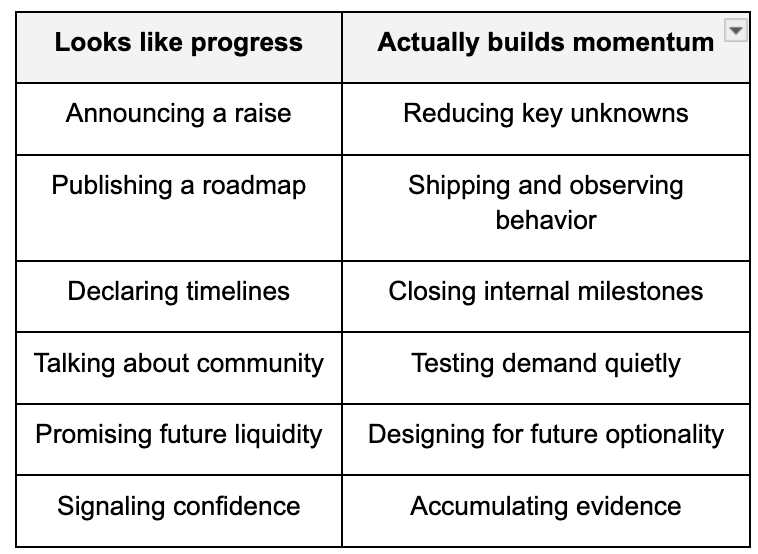
But momentum doesn’t come from making promises. It comes from reducing unknowns. A team that learns quietly rules out bad paths and moves faster than one that’s broadcasting progress without clarity. The difference is that one kind of momentum is visible, and the other is compounding.
Founders often get trapped by this false tradeoff. They assume they must choose between speed and optionality, between keeping things open and showing progress. But those aren’t opposites. You can move decisively without locking yourself into narratives or expectations you’ll later have to unwind.
The skill is knowing how to delay commitments without losing the momentum that actually matters.
Most founders don’t lose leverage by waiting too long. They lose it because they promised too early.
The first promise founders don’t realize they’re making
It’s usually not a legal promise.
It’s a narrative one.
The moment you raise money or float a token, you’re no longer just executing. You’re signaling. Even if nothing is written down, people start filling in the blanks. About timelines. About outcomes. About what kind of company this is supposed to become.
That’s the real shift. Expectations form before contracts ever do.
Investors, users, and the broader market begin to anchor on what they think you meant. And once those anchors set, they’re hard to move without friction.
Here are a few common examples.
“We’re building with the community.”
What founders often mean is early feedback, light participation, maybe distribution later. What others hear is governance, influence, or a say in direction. Pulling back later feels like betrayal, even if nothing was promised.“Liquidity will come later.”
This sounds safe and vague. But it still creates a clock in people’s heads. Later becomes a date. A delay becomes a signal. Suddenly, you’re managing sentiment instead of product.“This won’t affect future rounds.”
That’s almost never true. Structure leaks forward. New investors ask questions. Old ones reference precedent. You’ve constrained future design without realizing it.
None of these statements is a lie. They’re just incomplete. And once they’re out there, they narrow your room to maneuver.
This is where irreversibility starts, not with paperwork, but with stories that others begin to rely on.

Why some commitments are sticky, and others aren’t
Not all commitments weigh the same.
Private commitments are flexible. You can change your mind, reroute, or quietly abandon a path as you learn more. Public ones are different. The moment something is said out loud, especially in public, it stops being yours alone. It becomes something others track, repeat, and hold you to.
There’s also a big difference between committing to people and committing to mechanisms.
Commitments to people create emotional and social bonds. Backers, early community members, partners. Walking those back feels personal, even when it’s rational. Commitments to mechanisms are cleaner. Rules, thresholds, designs, or systems that can evolve without making anyone feel misled.
Markets amplify this effect. They remember signals long after the documents fade. Tweets, forum posts, early decks, offhand comments. None of it is binding on paper, but all of it shapes credibility.
You can revise plans.
You can’t revise trust.
The false tradeoff: speed vs optionality
Founders often think speed requires commitment. They may think that to move fast, you have to lock something in. As if you have to announce a raise, ship a token, or declare a roadmap.
That’s usually backward.
What looks like speed is often just signaling. It creates motion on the surface while slowing real work underneath. When this happens, teams start optimizing for consistency with past statements instead of learning. Execution bends around narrative.
Optionality doesn’t kill momentum. It protects it.
Real momentum comes from closing unknowns, shipping small things, and running constrained experiments. It involves talking to users and tightening the system before naming it. None of that requires promises.
So to reframe: Momentum without promises. Progress without permanence.
That’s how teams move fast early without trapping themselves later.
3 design patterns that preserve momentum without locking you in
Some teams keep moving without creating promises they’ll regret. Not by going slower, but by being deliberate about what they reveal and when.
One pattern is signaling progress without pointing to the future. Here, you show what exists, not what will exist. Think demos instead of roadmaps, ot learnings rather than timelines. This pattern keeps attention on reality rather than projection.
Another pattern is to use internal milestones rather than external deadlines. The team knows what “done enough” looks like, but the outside world doesn’t get a clock to hold you against. You keep pressure where it’s useful and avoid it where it distorts behavior.
Strong teams also validate privately before they align publicly. They test demand, pricing, and behavior in small, contained ways. Only after something holds up do they name it. By then, the risk has already been burned down.
In the end, there’s a quiet but essential distinction between testing demand and selling governance. You can see whether people care without handing them influence, rights, or expectations that are hard to unwind later.
None of this is about secrecy. It’s about sequencing.
What delaying well unlocks later
You could say that delaying well doesn’t stall progress - it compounds it. When you finally raise, the story is cleaner. Fewer caveats. Less backtracking. You explain what is, not what might be.
Your negotiating position improves, too. Earlier promises or half-formed structures do not box you in. You choose terms instead of inheriting them.
There are also fewer stakeholders to unwind, and fewer early commitments that need explaining or fixing. This alone saves months.
More importantly, execution speeds up once you do commit. Decisions stick, and teams stop hedging. The energy spent managing expectations goes back into building. This is where constraint pays off.
A subtle counterargument (and why it fails)
“If you don’t commit early, you lose attention.”
It sounds reasonable. In fast markets, attention feels fragile. Miss the moment, and it’s gone. So founders rush to lock something in, hoping momentum will carry them.
In practice, attention decays more slowly than optionality.
Genuine interest sticks around when progress is real. The right people don’t disappear because you didn’t announce a date or ship a token. They wait because they’re watching a signal, not noise.
The kind of attention you lose by not committing early is usually the wrong kind—people who need a promise to stay interested. Keeping them often costs more than losing them.
When momentum is real, the people who matter can feel it. They don’t need guarantees - they need evidence. This is what keeps credibility high.
The design skill founders actually need
Good founders aren’t defined by how fast they commit. They’re defined by how precisely they do it.
Commitment timing isn’t a personality trait - it’s a capability. Something you learn to design, just like product scope or system architecture.
The best founders aren’t cautious, but exact. They know which decisions are cheap to reverse and which ones aren’t. They delay the irreversible ones until the information is there. This points to the difference between delay and indecision.
Whereas indecision avoids choice because it’s uncomfortable, delay is a choice. One that protects leverage, clarity, and trust until the moment commitment actually makes the company stronger.
Closing: The promise you should be making
The most important promise isn’t to investors or to a community. It’s for the company you’re building.
And this promise is simple. Don’t trade future clarity for short-term relief. Don’t lock in stories you’ll later have to defend. Protect the ability to make good decisions when it actually counts.
Waiting, done right, isn’t avoidance. It’s preparation.
There will be a moment when delay stops being an option, when capital enters, when structure hardens, and when design choices become permanent.
The next issue looks at that moment head-on.
The irreversible point in token fundraising.
And why, once you cross it, design is no longer optional.